
NEWS AND EVENTS
PRESS CENTER
Welcome to the Fisher Technology Press Center. Here you will find all the latest and greatest information from our team! From expert BPA Advise from our top technical consultants, to personal anecdotes from our team.
Most businesses have already made the investment. There’s an ERP system handling finance, inventory, and operations. There’s a CRM managing customer relationships. There might be an e-commerce platform processing orders, a warehouse system tracking stock, and a courier integration handling shipping. Each one does its job. The problem is they don’t talk to each other.
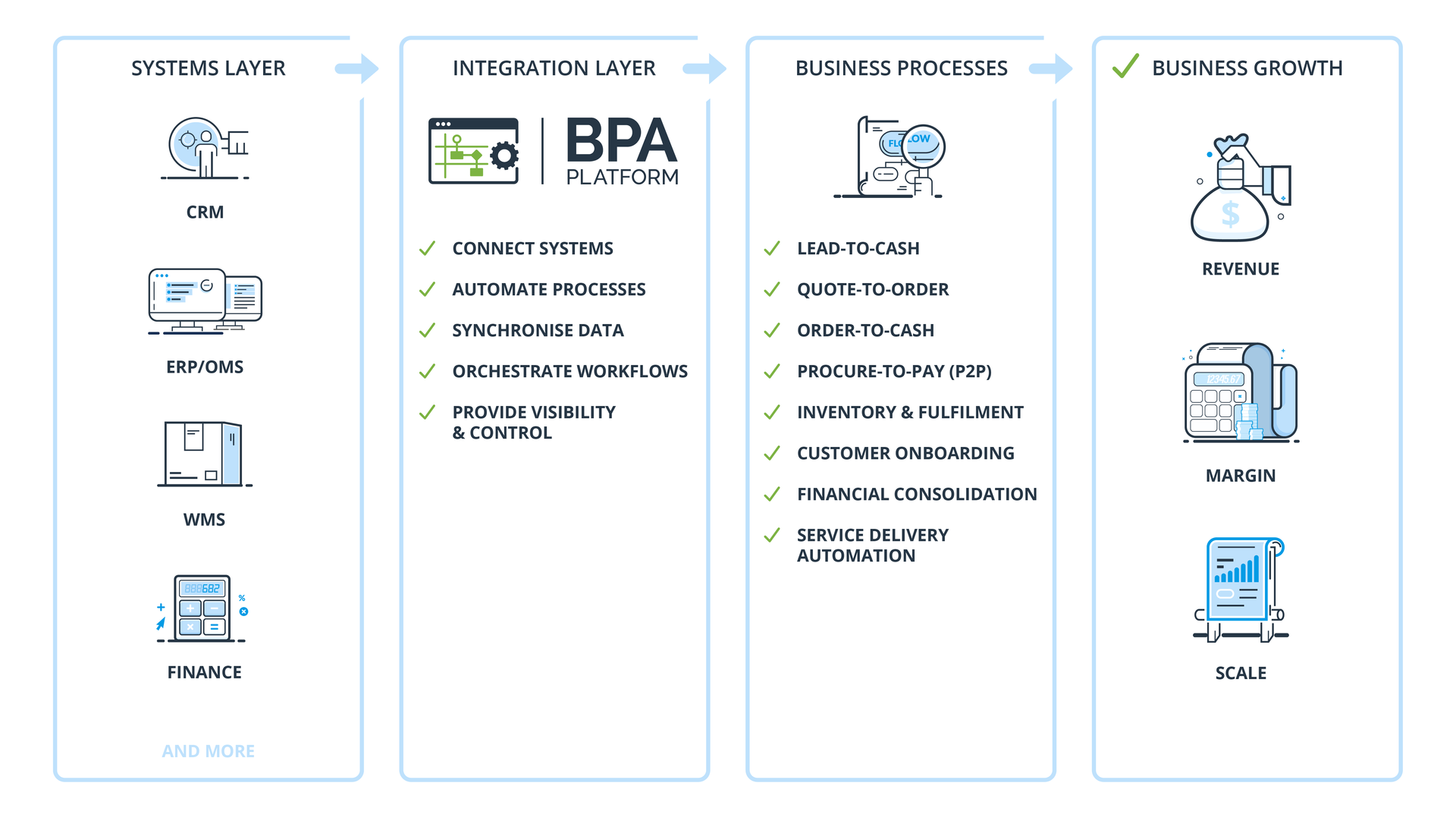
Growing a business is hard enough. The answer rarely means buying more software. It means making what you already have work together. Most businesses are running a mix of systems that each do their job reasonably well in isolation. Accounting in one platform, customer data in another, orders coming in through a separate channel entirely. The problem isn’t the individual tools. It’s the gaps between them. And those gaps, filled daily by manual workarounds, duplicated data entry, and out-of-date reports, are quietly costing more than most business owners realize. When those gaps close, something shifts. The business doesn’t just run more smoothly. It becomes capable of things it couldn’t do before. What disconnected systems actually cost you The cost of poorly connected systems rarely shows up as a single line item. It shows up as the hour your finance team spends every morning manually transferring data between platforms. It shows up as the sales rep who quoted a price based on inventory that had already sold. It shows up as the leadership team making decisions from a report that was already out of date by the time it landed in their inbox. Individually, each of these problems feels manageable. Collectively, they represent a significant drag on the business. Time that should be going into growth goes into workarounds. Decisions that should be made confidently get delayed because nobody quite trusts the data. And as the business grows, the problem compounds rather than resolves itself. Integration as a growth strategy, not an IT project There’s a tendency to think of system integration as something the IT department handles quietly in the background. That framing is part of the reason so many businesses stay stuck with systems that don’t work together. Integration is a business decision. When your systems share data seamlessly, your team spends less time moving information around and more time acting on it. When a new order placed online automatically updates your inventory, triggers a fulfillment workflow, and posts to your accounts without anyone touching it, that’s not just efficiency. That’s a business that can scale without adding headcount to manage the seams between systems. BPA Platform makes this kind of integration possible without requiring a team of developers or a lengthy implementation project. Using a simple drag-and-drop interface, it connects the systems your business already relies on and automates the workflows between them. The result is a business that runs more smoothly, responds more quickly, and is better positioned to grow. Connecting the systems you already have One of the most common concerns I hear from business owners is that integration sounds like it means replacing everything they’ve already invested in. It doesn’t. BPA Platform connects to the systems you already use, whether that’s Sage, SAP, Microsoft Dynamics, Salesforce, Shopify, or virtually any other platform your business runs on. That matters because most growing businesses have a mix of older, established systems and newer cloud-based applications. The platform that’s been running the business for a decade isn’t going anywhere, and it shouldn’t have to. BPA Platform works across cloud, on-premise, and hybrid environments, so you can build the connections your business needs without disrupting what’s already working. Security is built into the integration layer rather than bolted on afterward. Data moving between your systems is protected end to end, which matters particularly for businesses handling sensitive financial, customer, or operational information. What this looks like in practice Consider a business that sells through multiple channels. Orders come in online, through a sales team, and via wholesale partners. Each channel feeds into a different system. Without integration, someone is manually reconciling those orders, updating stock levels, and ensuring the accounts reflect what’s actually been sold. With BPA Platform in place, that entire process runs automatically. An order placed anywhere updates inventory everywhere, triggers the right fulfillment process, and posts to the accounts without a person in the middle. Or consider a leadership team that currently waits until month end to see how the business is performing. With automated reporting built on integrated data, that same team can have accurate, real-time visibility into the numbers that matter most, every day, without anyone spending time pulling the report together. These aren’t complex transformations. They’re the kind of straightforward improvements that free up your best people to focus on growth rather than administration. Growing without growing the complexity The businesses that scale most effectively are the ones that build operational foundations capable of supporting growth before they need them. Integration is one of those foundations. A business that has its systems working together is a business that can take on more customers, enter new markets, and move faster without the wheels coming off. BPA Platform is designed to scale with the business. Whether you’re connecting two systems today or building out a broader automation framework over time, the platform grows with your requirements rather than forcing you to start over when your needs change. If your systems are creating friction rather than enabling growth, it’s worth having an honest conversation about what that’s costing you and what a more connected business could look like. That’s exactly the kind of conversation we enjoy having at Fisher Technology. _________________________________________________________________________________________________________________________________________________________ Fisher Technology helps businesses across North America connect their systems and automate their workflows using BPA Platform. If you’d like to explore what better integration could mean for your business, we’d love to talk. Get in touch: www.fisher-technology.com/contact

Finance teams are often described as the engine room of a business. They keep the numbers accurate, the cash flowing, and the reporting on time. But in many organizations, a significant portion of that team’s energy goes into tasks that are repetitive, manual, and frankly not a great use of skilled people. That’s where business process automation comes in. And when it’s applied thoughtfully to finance, the results go well beyond efficiency gains. Done right, automation repositions a finance team from a cost center into something that actively contributes to business growth. The Problem With Manual Finance Processes Most finance teams are sitting on processes that haven’t changed much in years. Reports get generated by hand. Invoices are chased through spreadsheets and email threads. Credit control relies on someone remembering to follow up. Reconciliation happens in a mad scramble at month end. These tasks are necessary, but they don’t need to be manual. And when they are, the cost isn’t just time. Errors creep in. Deadlines get missed. Cash flow suffers. And the finance professionals who should be providing strategic insight spend their days on administration instead. “When skilled finance people spend their days on administration, the business loses the strategic thinking it’s paying for.” What Automation Actually Looks Like In Practice BPA Platform addresses this by automating the repetitive, rule-based work that clogs up finance workflows. That includes the automatic generation and distribution of invoices and statements, automated credit control procedures that send the right communication to the right customer at the right time, purchase order approval workflows that route requests based on value thresholds, and scheduled financial reporting that lands in the right inbox without anyone having to build it. The platform integrates with the accounting and ERP systems finance teams already use, including Sage, SAP, Microsoft Dynamics, and many others, so there’s no need to rip out existing infrastructure. Automation gets layered on top of what’s already working. A Real Example: What This Looks Like For A Finance Team One pattern that comes up consistently across BPA Platform customers is the reporting burden. Finance and operations teams often spend several hours every week manually building, formatting, and distributing reports that nobody has time to question or redesign because they’ve always been done that way. With BPA Platform’s reporting automation in place, those reports are generated and distributed automatically in real time. The staff time that was going into assembly gets freed up for analysis. Errors that crept in through manual data handling disappear. And the people responsible for financial reporting can focus on what the numbers mean rather than how to produce them. Codeless Platforms’ customers across industries have seen this play out in reporting, reconciliation, and financial administration. The time savings are consistent, and so is the observation that the real benefit isn’t just the hours recovered. It’s what the team does with them. Credit Control: Where Automation Directly Protects Cash Flow One of the highest-impact areas for finance automation is credit control. Late payments are one of the most common causes of cash flow pressure for businesses of all sizes, and most of the time, the problem isn’t that customers won’t pay. It’s that nobody followed up in a consistent, timely way. BPA Platform can monitor outstanding invoices daily, automatically generating and sending the right communication based on how overdue an account is. An approaching due date triggers a polite reminder. A missed payment triggers a follow-up. An aged debt triggers an alert to the collections team and the relevant account manager simultaneously. The whole process runs without anyone having to track it manually, and nothing falls through the cracks. For businesses that have implemented this kind of automated credit control, the results tend to show up quickly. Aged debtor times come down. Cash flow becomes more predictable. And the finance team spends less time chasing and more time managing. For businesses that have implemented this kind of automated credit control, the results tend to show up quickly. Aged debtor times come down. Cash flow becomes more predictable. And the finance team spends less time chasing and more time managing. The B roader Shift: From Reactive To Strategic The real value of finance automation isn’t just the hours saved, though those matter. It’s what becomes possible when the team has capacity to think rather than just process. Real-time visibility into cash flow. Faster month-end close. Earlier identification of risk. More informed conversations with leadership about where the business stands and where it’s heading. Finance teams that automate the routine work don’t just get more efficient. They get more valuable to the business. And that’s the transformation worth aiming for. “Finance teams that automate the routine work don’t just get more efficient. They get more valuable to the business.” --------------------------------------------------------------------------------------------------------------------------------------------------------------------------------------------------------------------------------------------- Fisher Technology helps organizations across North America implement BPA Platform to streamline finance operations and unlock the full potential of their teams. If you’d like to explore what automation could look like for your finance function, we’d love to talk. Get in touch: www.fisher-technology.com/contact

Sit through enough software demos and a pattern starts to emerge. Somewhere between the slide on streamlined workflows and the one about real-time visibility, the presenter leans forward and drops the phrase: AI-powered. The room nods. Someone scribbles it down. And the question nobody says out loud is "what does that actually mean?" To be fair, AI is genuinely changing enterprise software. Real progress is happening in how systems learn from data, flag problems early, and cut down on manual grunt work. This isn’t an argument that AI is all smoke and no fire. It’s an argument that not all AI is the same thing, and that mid-market buyers are getting a raw deal when it comes to telling the difference. The Pressure to Lead with AI Mid-market ERP and CRM vendors are caught in a tough spot. Enterprise players have poured billions into AI, and their customers are asking the same questions regardless of company size. So “AI-powered” has quietly shifted from being a technical description to a marketing checkbox, something that needs to show up on the website, in the pitch deck, and in the renewal conversation, whether the product genuinely justifies it or not. This isn’t a dig at any one vendor. It’s the water the whole industry is swimming in right now. When buyers expect AI and competitors are claiming it, stretching the definition becomes hard to resist. The result is a market where “AI-powered” can mean anything from a genuinely sophisticated machine learning model to a rebranded reporting dashboard. Both might be useful. But they’re not the same thing, and they shouldn’t carry the same price tag. What “AI-Powered” Often Looks Like in Practice A few patterns come up again and again: Predictions that are really just history repeating. If a system flags a customer as “at risk” because their order frequency dropped, that’s not a prediction, that’s a report. Useful, sure, but it’s been available for years. Platforms like BPA Platform have delivered exactly this kind of data-driven alerting and exception reporting through straightforward business rules and workflow logic, long before anyone was calling it AI. The capability was always real. The rebrand is what’s new. Automation dressed up as intelligence . Routing an invoice to the right approver based on a spend threshold. Triggering a follow-up when an order status changes. Escalating a support case that’s been sitting too long. These are rules-based processes and BPA Platform handles them through its low code automation engine without needing a machine learning model anywhere near them. They’re reliable, auditable, and they work. When vendors slap an AI label on this kind of automation, it doesn’t make the feature more powerful. It just makes the buying conversation murkier. Generative AI bolted on rather than built in . The scramble to add large language model features to existing products has produced some genuinely useful results and some that are basically a chat window glued onto software that hasn’t fundamentally changed underneath. The question worth asking isn’t whether there’s a generative component. It’s whether it’s working from relevant data, wired into actual workflows, and backed by someone who’ll own the problem when it gets something wrong. A Simple Framework for Evaluating AI Claims A Simple Framework for Evaluating AI Claims You don’t need a data science background to push back on what vendors are telling you. A handful of direct questions will do most of the work: Whose data is it learning from? Ours, or a generic model? A system trained on your business behaves very differently from one drawing on industry-wide averages. What happens when it gets it wrong? Every AI system makes mistakes. How a vendor answers this question says a lot about how seriously they’ve thought it through. Who owns it when something breaks or changes? Features tied to third-party models can shift behavior when those models are updated. That’s a support question, not a technical footnote. Can we see it running in a live environment? Demo environments are controlled by design. Asking to speak with a reference customer who uses the feature in production is a completely fair request, and the answer tells you a lot! So So What Should You Actually Do? None of this is a case for tuning out AI conversations entirely. Informed skepticism is different from blanket cynicism. AI is developing fast, and what isn’t quite there yet could look very different in two or three years. The vendors worth watching are the ones building seriously on solid data foundations — and being straight with customers about what’s ready and what isn’t. The ones worth being cautious about are using AI language mainly to justify price rises, paper over product gaps, or match a competitor’s latest press release. Your business deserves sharper questions than that. Ask them. The vendors with real answers won’t mind. -------------------------------------------------------------------------------------------------------------------------------------------------------------------------------------------------------------------------------------- Full disclosure: this blog was written with the help of Claude, Anthropic’s AI assistant. Yes, we’re aware of the irony — a post about not blindly trusting AI was drafted with the help of AI. But that’s rather the point. Used thoughtfully, with a human steering the ideas, challenging the output, and rewriting the bits that sounded like a robot trying to sound like a person, AI can be a genuinely useful tool. It didn’t write this. It helped write this. There’s a difference — and that difference is exactly what this blog is about. What “AI-Powered” Often Looks Like in Practice
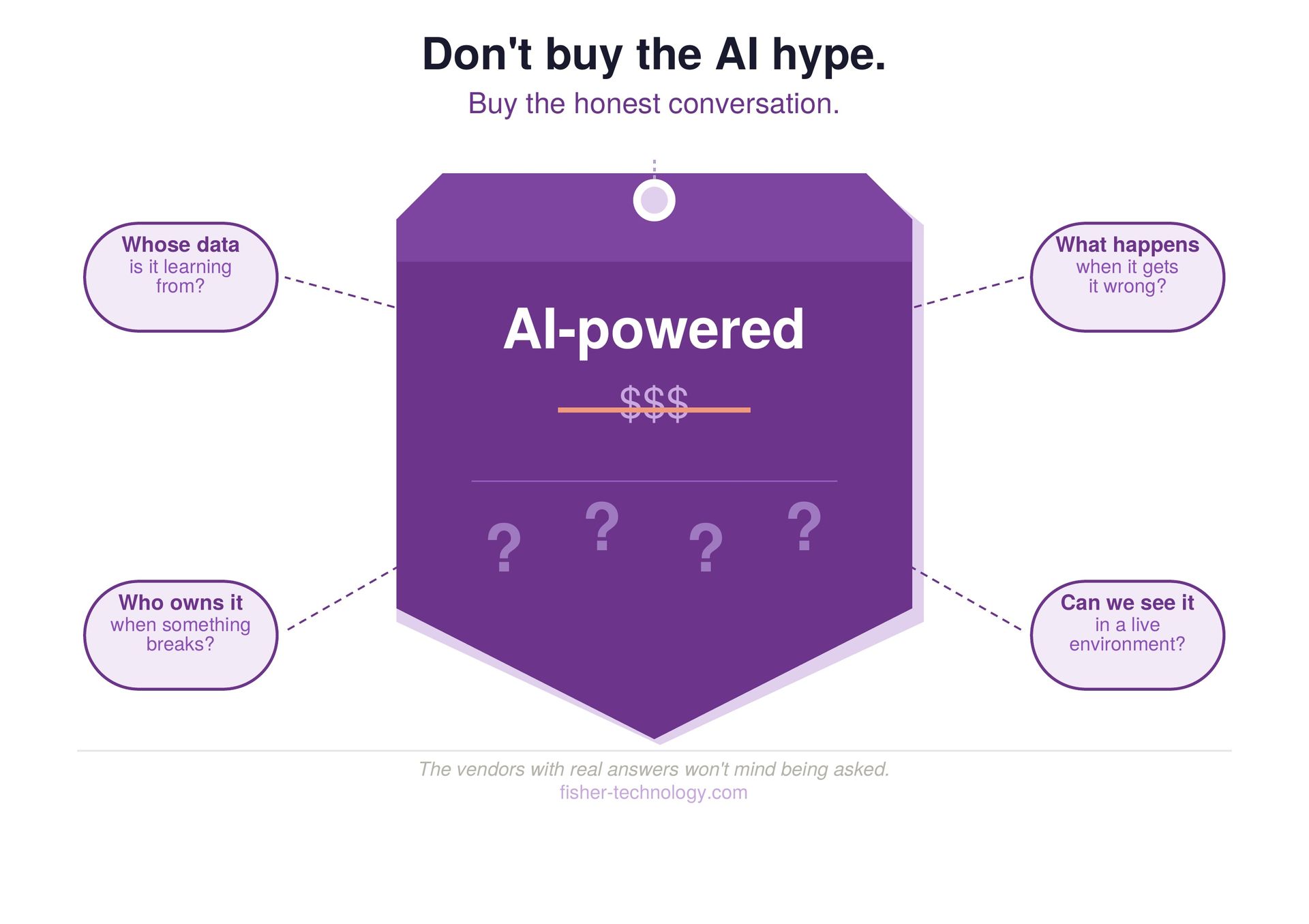
Sit through enough software demos and a pattern starts to emerge. Somewhere between the slide on streamlined workflows and the one about real-time visibility, the presenter leans forward and drops the phrase: AI-powered. The room nods. Someone scribbles it down. And the question nobody says out loud is — what does that actually mean? To be fair, AI is genuinely changing enterprise software. Real progress is happening in how systems learn from data, flag problems early, and cut down on manual grunt work. This isn’t an argument that AI is all smoke and no fire. It’s an argument that not all AI is the same thing — and that mid-market buyers are getting a raw deal when it comes to telling the difference. The Pressure to Lead with AI Mid-market ERP and CRM vendors are caught in a tough spot. Enterprise players have poured billions into AI, and their customers are asking the same questions regardless of company size. So “AI-powered” has quietly shifted from being a technical description to a marketing checkbox — something that needs to show up on the website, in the pitch deck, and in the renewal conversation, whether the product genuinely justifies it or not. This isn’t a dig at any one vendor. It’s the water the whole industry is swimming in right now. When buyers expect AI and competitors are claiming it, stretching the definition becomes hard to resist. The result is a market where “AI-powered” can mean anything from a genuinely sophisticated machine learning model to a rebranded reporting dashboard. Both might be useful. But they’re not the same thing, and they shouldn’t carry the same price tag. What "AI-Powered" Often Looks Like in Practice at “AI-Powered” Often Looks Like in Practice A few patterns come up again and again: Predictions that are really just history repeating . If a system flags a customer as “at risk” because their order frequency dropped, that’s not a prediction — that’s a report. Useful, sure, but it’s been available for years. Platforms like BPA Platform have delivered exactly this kind of data-driven alerting and exception reporting through straightforward business rules and workflow logic — long before anyone was calling it AI. The capability was always real. The rebrand is what’s new. Automation dressed up as intelligence . Routing an invoice to the right approver based on a spend threshold. Triggering a follow-up when an order status changes. Escalating a support case that’s been sitting too long. These are rules-based processes — and BPA Platform handles them through its codeless automation engine without needing a machine learning model anywhere near them. They’re reliable, auditable, and they work. When vendors slap an AI label on this kind of automation, it doesn’t make the feature more powerful. It just makes the buying conversation murkier. Generative AI bolted on rather than built in . The scramble to add large language model features to existing products has produced some genuinely useful results — and some that are basically a chat window glued onto software that hasn’t fundamentally changed underneath. The question worth asking isn’t whether there’s a generative component. It’s whether it’s working from relevant data, wired into actual workflows, and backed by someone who’ll own the problem when it gets something wrong. A Simple Framework for Evaluating AI Claims A Simple Framework for Evaluating AI Claims You don’t need a data science background to push back on what vendors are telling you. A handful of direct questions will do most of the work: Whose data is it learning from — ours, or a generic model? A system trained on your business behaves very differently from one drawing on industry-wide averages. What happens when it gets it wrong? Every AI system makes mistakes. How a vendor answers this question says a lot about how seriously they’ve thought it through. Who owns it when something breaks or changes? Features tied to third-party models can shift behaviour when those models are updated. That’s a support question, not a technical footnote. Can we see it running in a live environment? Demo environments are controlled by design. Asking to speak with a reference customer who uses the feature in production is a completely fair request — and the answer tells you a lot. So, What Should You Actually Do? What Should You Actually Do? None of this is a case for tuning out AI conversations entirely. Informed skepticism is different from blanket cynicism. AI is developing fast, and what isn’t quite there yet could look very different in two or three years. The vendors worth watching are the ones building seriously on solid data foundations — and being straight with customers about what’s ready and what isn’t. The ones worth being cautious about are using AI language mainly to justify price rises, paper over product gaps, or match a competitor’s latest press release. Your business deserves sharper questions than that. Ask them. The vendors with real answers won’t mind. ------------------------------------------------------------------------------------------------------------------------------------------------------------------------------------ Full disclosure: this blog was written with the help of Claude, Anthropic’s AI assistant. Yes, we’re aware of the irony — a post about not blindly trusting AI was drafted with the help of AI. But that’s rather the point. Used thoughtfully, with a human steering the ideas, challenging the output, and rewriting the bits that sounded like a robot trying to sound like a person, AI can be a genuinely useful tool. It didn’t write this. It helped write this. There’s a difference — and that difference is exactly what this blog is about.
Automation in finance plays an important role for an organization and is a key driver for moving the company forward. With the right automation tools, finance teams can directly impact the bottom line, accelerate cash flow, and unlock new growth opportunities. BPA Platform empowers finance professionals to transform from cost centers into profit generators, delivering measurable revenue impact across every financial process. From Cost Center to Revenue Engine: The Finance Transformation Traditional finance departments focus on expense management and compliance. But forward-thinking organizations are leveraging finance automation to drive revenue growth. BPA Platform enables this transformation by connecting financial processes directly to revenue outcomes, turning every automated workflow into a growth opportunity. When finance teams eliminate manual bottlenecks, they don't just save time—they accelerate revenue recognition, improve cash conversion cycles, and enable faster business decisions that capture market opportunities. This strategic shift positions finance as a competitive advantage and primary driver of company growth. Finance Automation with BPA Platform Cash flow is the lifeblood of revenue growth. BPA Platform's finance automation directly impacts your company's ability to generate and collect revenue by streamlining critical cash flow processes: Automated invoice generation reduces billing cycles from days to hours Intelligent payment routing accelerates customer payment processing Real-time payment tracking eliminates revenue recognition delays Automated dunning processes recover revenue faster from slow-paying customers Poor credit management doesn't just create bad debt—it destroys future revenue opportunities. BPA Platform's credit control automation protects revenue while enabling growth: Real-time monitoring identifies customers before they become collection problems Automated workflows prevent revenue leakage from account management gaps Integrated communication tools maintain sales relationships during collections BPA Platform transforms financial reporting from a backward-looking compliance exercise into a forward-looking revenue optimization tool: Real-Time Revenue Analytics Automated data consolidation provides instant revenue visibility Dynamic dashboards identify revenue trends as they happen Predictive analytics forecast revenue opportunities and risks Automated variance analysis highlights revenue optimization opportunities Strategic Decision Acceleration Automated reporting eliminates month-end delays that slow business decisions Real-time profitability analysis guides revenue-focused resource allocation Instant scenario modeling evaluates revenue impact of strategic options Core BPA Platform Solutions That Drive Revenue Journal Entry Automation: Revenue Recognition Acceleration Manual journal entries create dangerous delays in revenue recognition. BPA Platform's automated journal processing ensures revenue hits the books immediately when earned; eliminating month-end revenue recognition bottlenecks, enabling faster financial closes and more timely business decisions. Expense Management: Maximizing Profit Margins Every dollar saved in expense processing flows directly to profit margins. BPA Platform's expense automation doesn't just cut costs—it amplifies revenue impact. Expense savings from automation can be reinvested into revenue-generating activities, creating compound growth impact. Intercompany Management: Scaling Revenue Across Business Units Growing companies often struggle with intercompany transactions that slow revenue recognition and create compliance risks. BPA Platform enables seamless revenue flow across business entities eliminating intercompany transaction delays that prevent timely revenue recognition and business unit optimization. BPA Platform for Revenue-Driven Finance Transformation The most successful companies don't just manage finances—they leverage finance automation to drive revenue growth. BPA Platform provides the tools, integrations, and insights needed to transform your finance team from a cost center into your company's most powerful revenue driver. Your digital transformation starts with one conversation—and the sooner it begins, the sooner you gain the competitive edge. Contact Fisher Technology to discover why organizations across North America trust us to deliver automation solutions that drive efficiency, agility, and growth.

Organizations struggle with a fundamental challenge: their critical business data lives in two worlds. Essential systems remain on-premise for security and compliance reasons, while new cloud applications promise enhanced functionality and scalability. The result is often data silos, manual processes, and frustrated users who can't access the information they need when they need it. BPA Platform recognizes this reality and delivers what organizations actually need: a single integration and automation platform that works seamlessly across Cloud, On-Premises, or Hybrid environments without forcing businesses to choose just one deployment model. How BPA Platform Addresses Hybrid Integration Challenges Modern enterprises operate in a complex ecosystem where legacy on-premise systems must work harmoniously with cloud-based applications. This hybrid environment presents unique challenges including data synchronization, security concerns, varying communication protocols, and the need for real-time connectivity. Organizations require solutions that can maintain data integrity while enabling seamless workflows across both environments. BPA Platform addresses these challenges through: Tasks & Steps Framework - BPA platform provides the ability to build flexible automation processes with logical building blocks using an intuitive drag-and-drop interface. Comprehensive Tool Library - BPA platform includes tools used to create steps within a task, providing functional building blocks that interface with common technologies, systems, and applications across cloud and on-premise environments. Secure Integration - BPA Platform integrates cloud-based, on-premises, or hybrid hosted business systems using end-to-end AES 256 security with double encryption to protect business data and transactions. This security-first approach ensures that sensitive data remains protected regardless of where it travels. Flexible System Architecture - BPA platform can be deployed on-premises or as an iPaaS (Integration Platform as a Service). It uses client software to design tasks, a server for connectivity and processing, and a data store for data and tasks. Multi-Protocol and Format Support - BPA Platform empowers you to bring all your data workflows together, supporting a wide variety of file formats and protocols including XML, CSV, JSON, HTTP, SMTP, OAuth, and more to drive your business forward seamlessly across different systems and applications. This comprehensive protocol support ensures that virtually any system can be integrated without requiring costly custom development. For organizations looking to optimize their hybrid IT architecture, BPA Platform's cloud integration solutions offer a proven path to success, combining the reliability of on-premise systems with the scalability and innovation of cloud platforms. Benefits of BPA Platform BPA Platform delivers comprehensive integration value through key capabilities that address critical enterprise needs: Reduced Development Time and Costs - BPA Platform significantly reduces system integration development times and costs while supporting integration with any data source. The platform provides flexibility to maintain, configure, and adapt data synchronization as business requirements change. Universal Connectivity - Connect to any SaaS or on-premises application or system through an extensive library of pre-built connectors and business process automation tools. This eliminates integration limitations and reduces implementation time. Scalable Architecture - Multi-instance architecture ensures reliable performance with multiple integration processes running simultaneously. Enhanced fault tolerance maintains system stability and business continuity. Flexible Processing - Support for both real-time processing and batch data integration handles different business requirements within a single platform, from immediate data synchronization to large-volume reporting tasks. Enterprise Security - Powerful authentication, access control, and data encryption protect sensitive information throughout the integration process, ensuring compliance with regulatory and corporate security requirements. These benefits deliver immediate ROI through faster integration development, improved operational efficiency, and reduced maintenance overhead while positioning organizations for long-term integration success. Hybrid Integration Excellence with BPA Platform As organizations advance, the need for flexible, secure, and scalable integration solutions becomes increasingly critical. BPA Platform empowers businesses to achieve true hybrid integration, seamlessly connecting systems and applications across both cloud and on-premises environments. Designed to support a multilayered, enterprise-wide technology architecture, BPA Platform enables complete interoperability between your existing tools and future innovations. This not only solves today’s integration challenges but also provides a resilient foundation for growth, adaptability, and the adoption of emerging technologies. By choosing BPA Platform, organizations position themselves for long-term success — with the agility to support evolving business models and ever-changing market conditions. Ready to Transform Your Integration Strategy? For organizations looking to optimize their hybrid IT architecture, BPA Platform's comprehensive integration solutions offer a proven path to success, combining the reliability and control of on-premise systems with the scalability and innovation of cloud platforms. Whether you're supporting multiple applications across multi-cloud environments, enabling digital transformation initiatives, or ensuring compliance with industry regulations, BPA Platform delivers the secure, flexible connectivity your business needs to thrive. Ready to discover how BPA Platform can transform your organization's integration capabilities? Contact Fisher Technology today; we can assess your current environment, understand your business objectives, and provide you with a clear roadmap to integration success!

It seems like everywhere you turn—from coffee shop conversations to boardroom meetings—artificial intelligence dominates the discussion. As someone who's spent years in the technology industry, I've watched this wave of Ai enthusiasm with both excitement and a healthy dose of realism. The AI Conversation Everyone's Having There's no denying that Ai has captured our collective imagination. Social media feeds are flooded with ChatGPT screenshots, businesses are scrambling to integrate AI solutions, and investors are throwing money at anything with "Ai-powered" in the pitch deck. The enthusiasm is infectious, and frankly, some of it is well-deserved. Working in technology, I've been hearing countless questions from colleagues and partners about how they can leverage Ai to transform their operations. The questions range from the practical "Can Ai help us automate our customer service?" to the almost magical "Can Ai solve all our efficiency problems?". This spectrum of expectations tells a story about where we are in the Ai adoption curve—somewhere between realistic optimism and unrealistic expectations. Ai's Real Role in Technology Here's the thing about Ai that I wish more people understood: it's incredibly powerful, but it's not omnipotent. In the technology industry, Ai serves as an amplifier of human capabilities, not a replacement for human judgment and creativity. The most successful Ai implementations I've observed across the industry have been those where Ai addresses specific, well-defined problems. For example, companies are using machine learning to optimize supply chain logistics, reducing waste and improving delivery times. Others are leveraging it to automate quality control processes, catching defects that might slip past human inspection. Many businesses are also deploying Ai-powered phone systems to handle initial customer inquiries and schedule meetings, eliminating the need for expensive answering services while freeing up employees to focus on higher-value client interactions. A Powerful Assistant, Not the Whole Team This brings me to my main point—Ai is an assistant. It’s sophisticated, intelligent, and powerful, but not a standalone solution. Too often, I see businesses approaching Ai as if it's the missing puzzle piece that will magically solve all their operational challenges. The reality is messier and more nuanced. Successful Ai implementation requires the same fundamentals as any other technology project: clear objectives, quality data, proper infrastructure, and ongoing maintenance. You need to understand your current processes before you can improve them with Ai. Most importantly, you need humans who understand both the technology and the business context to make Ai work effectively. Looking Forward Realistically As we continue to navigate this Ai revolution, I encourage business leaders to maintain a balanced perspective. Embrace the possibilities that Ai offers, but approach them with realistic expectations and solid planning. At Fisher Technology, we're excited about the future of Ai and its potential to drive innovation across industries. But we're equally committed to helping our clients understand that Ai's greatest value lies not in replacing human judgment, but in augmenting it. The conversation about Ai will undoubtedly continue to evolve, and that's a good thing. As the technology matures and our understanding deepens, we'll find even more creative and effective ways to harness its power. Just remember: Ai is a powerful tool in our technological toolkit, but like any tool, its value lies in how skillfully and thoughtfully we use it.
Automation has become essential for organizations seeking efficiency and competitive advantage. BPA (Business Process Automation) Platform provides powerful tools that streamline operations across departments, empowering employees at all levels to accomplish more with less manual effort. Warehouse Management Transformation Warehouse operations rely on precision, speed, and real-time visibility—BPA Platform delivers all three by seamlessly integrating with your existing warehouse management systems. By automating inventory tracking, order fulfillment, shipping notifications, and stock reconciliation, the platform eliminates tedious manual processes and reduces the risk of errors. Additionally, it can trigger automatic reordering when stock reaches critical thresholds, synchronize picking, packing, and shipping to cut down fulfillment time, and generate actionable performance analytics to identify bottlenecks before they disrupt operations. With BPA Platform, your warehouse team can focus on value-added tasks and exception handling, driving both efficiency and customer satisfaction. Support Ticket Resolution Acceleration BPA Platform empowers customer service teams by automating key aspects of support ticket management. Through intelligent routing based on predefined rules and content analysis, tickets are automatically assigned to the appropriate specialists, reducing response times and ensuring consistent, high-quality support. Issues are prioritized according to customizable business logic, while automated status updates keep customers informed every step of the way. The platform also integrates with knowledge bases to suggest solutions for common problems, enhancing both agent efficiency and customer satisfaction. With comprehensive performance reporting and pattern analysis, BPA Platform not only improves resolution times but also delivers the insights needed to continually refine support operations. CRM Enhancement for Deeper Relationships When integrated with CRM systems, BPA Platform empowers sales and marketing teams to build deeper, more personalized customer relationships. Automated data enrichment pulls insights from multiple touchpoints, creating comprehensive customer profiles and enabling precise segmentation. Timely alerts for follow-ups and renewals ensure sales teams never miss an opportunity, while intelligent lead scoring streamlines qualification efforts. Marketing campaigns benefit from behavior-triggered communication flows and synchronized data across departments, resulting in a unified customer view. The outcome: improved conversion rates, stronger forecasting, and more effective, personalized engagement at every stage of the customer journey. ERP Integration for Operational Excellence BPA Platform transforms fragmented ERP systems into a unified, agile ecosystem by seamlessly connecting data across departments like finance, HR, procurement, and production. By eliminating duplicate data entry and automating key workflows such as financial reconciliation, reporting, and approval routing, the platform reduces errors, improves compliance, and accelerates processes like financial close. With real-time data flowing between modules, leadership gains comprehensive visibility and actionable insights to drive smarter, faster decision-making. Transform Your Business Today with BPA Platform Don't let manual processes hold your business back any longer. Fisher Technology can help bring the full power of BPA Platform to your organization, customized to your unique processes and integration needs. Contact us today for a personalized consultation and discover how our automation solutions can drive efficiency, reduce costs, and position your business for sustainable growth in an increasingly competitive marketplace.
When your business uses different tools and softwares that don't communicate, critical information can get lost and workflows can break down. This blog explores how Integration Platform as a Service (iPaaS) solves this problem by connecting your essential business applications. We'll cover why iPaaS is the best choice to help businesses overcome common challenges, the key benefits of implementing an integration platform, and a look at BPA Platform's specific iPaaS capabilities. Keep on reading to discover how the right integration strategy can transform scattered data into a powerful, unified business resource. Why iPaaS? Data visibility across an organization is crucial for improving efficiency, seizing new opportunities, and identifying potential threats. In the past, businesses operated within a single system, but today, the vast array of available software has led different departments to adopt applications tailored to their specific needs. While these tools enhance departmental efficiency, they also contribute to data silos, where critical information is stored in separate locations. This fragmentation can disrupt sales and accounting processes, hinder collaboration, create inefficiencies, and increase the risk of data errors. Integration Platform as a Service (iPaaS) provides a cloud-based solution that seamlessly connects, automates, and manages applications, systems, and data across business environments. By replacing traditional middleware with a standardized approach, iPaaS delivers cost-effective integration capabilities. How does iPaaS work? iPaaS is a cloud integration platform that creates a centralized ecosystem for managing data workflows. The platform offers pre-built connectors and automation tools that seamlessly link applications, services, and databases. With iPaaS, businesses gain a unified view of their integration landscape, allowing them to control and modify data flows across their infrastructure. As organisations grow, iPaaS scales effortlessly; new systems and services can be connected without significant cost, and custom functionality can be implemented to meet evolving business needs. The Advantages of iPaaS Reduced costs: Saves costs by automating integrations, reducing manual processes, and improving operational efficiency, which minimizes IT expenses and resource allocation. Reduced resources: Reduce the amount of time and number of personnel concentrating on system integration and data migration. Improved scalability: Easily add new applications and tweak business processes as the business grows. Centralised management: Once central ecosystem to manage data, integrations, processes, and workflows. Improved decision making: With access to real-time data across an organisation, employees and management can make better decisions to help improve efficiencies. ROI: iPaaS can help businesses drive company revenue and go to market quicker. BPA Platform’s iPaaS Solution BPA Platform’s iPaaS tool capabilities include: Drag and drop integration between cloud-based and on-premises systems and applications so that system integration steps are visually represented within a wider automated process. Innovative transformation functions that can be dragged onto the mapping area to change the data between inputs and outputs. RESTful web service integration by removing the need for bespoke development. SOAP web services integration Support OData and SData services Transform Your Business Integration Strategy with iPaaS As businesses continue to navigate the complexities of digital transformation, iPaaS solutions stand out as essential tools for maintaining competitive advantage. By breaking down data silos and creating seamless connections between applications, iPaaS empowers organizations to harness the full potential of their data. The result is not just improved operational efficiency, but also enhanced agility to respond to market changes, better customer experiences through integrated data flows, and ultimately, accelerated business growth. Ready to eliminate data silos in your business? Contact Fisher Technology today to learn more about how BPA Platform's powerful iPaaS capabilities can transform your integration challenges into competitive advantages. Don't let disconnected data hold your business back!