
Integration Solutions for Business Growth

Nicole Laurier • September 23, 2024

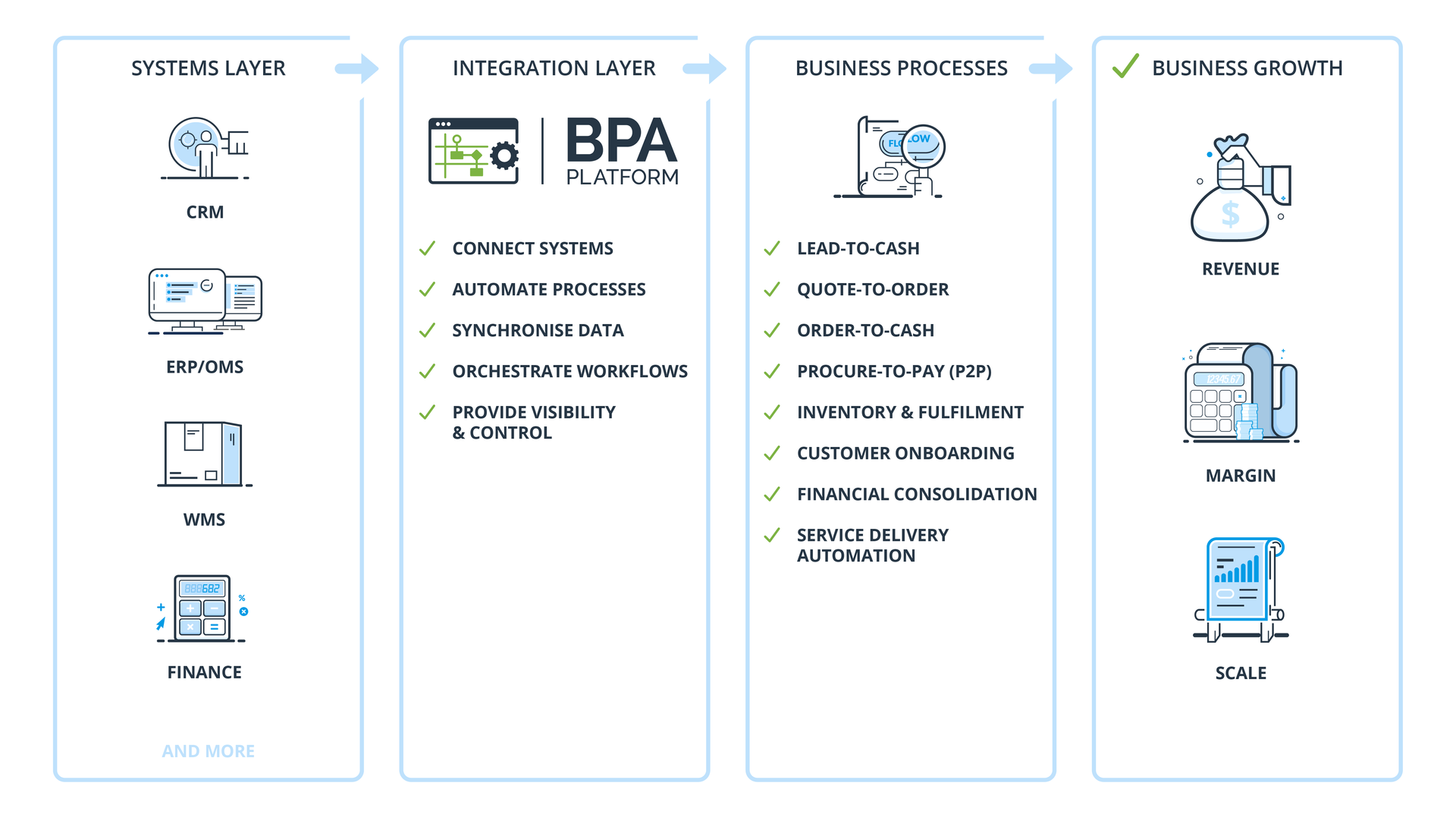
A key part of adapting to today’s digital landscape is seamlessly integrating different business softwares and systems to optimize operations and boost productivity. This is where BPA Platform comes in; with its cutting-edge tools BPA Platform can revolutionize your business. Whether you're a new entrepreneur or seasoned business owner, mastering these tools can transform your operations and pave the way for success.


The Role of BPA Platform in Business Operations


The use of BPA Platform is becoming increasingly vital as businesses strive for efficiency. This platform enables organizations to automate repetitive tasks, freeing up valuable resources and allowing teams to focus on strategic initiatives. But what makes BPA Platform truly invaluable, is its ability to connect disparate systems and data sources seamlessly. This connectivity ensures that data flows smoothly across the organization, eliminating silos and enhancing collaboration.

For businesses aiming to stay competitive, integrating systems through BPA Platform is no longer optional—it's essential. By using various tools, companies can automate processes, reduce manual input errors, and improve decision-making through real-time data access. In essence, BPA platform lays the groundwork for digital transformation, providing a robust framework for innovation and growth.


Enhancing Connectivity for Your Business


Selecting the right integration for your business is a crucial step in optimizing your operations. However, with so many options available, it can be overwhelming to decide which ones best suit your needs. Here's a guide to help you make informed choices.

First, assess your current systems and identify any inefficiencies or bottlenecks. Are there processes that could benefit from automation? Are there data silos that hinder collaboration? Understanding these pain points will help you determine which integration is required to address them.

Next, consider how BPA Platform will seamlessly integrate with your current systems. As your organization grows, your integration needs will evolve, and BPA Platform is designed to adapt alongside you. By enabling smooth connectivity across various applications, BPA Platform ensures long-term compatibility and optimal performance, empowering your business to scale efficiently and effectively.

Finally, evaluate the ease of implementation. Opt for integration that is user-friendly and comes with comprehensive support and documentation. This will minimize disruptions during the integration process and ensure your team can quickly adapt to the new systems.


The Transformative Impact of BPA Platform


BPA Platform is the key to unlocking the full potential of your systems and data, driving efficiency, innovation, and growth. With increased connectivity, businesses can eliminate data silos, ensuring that information is accessible and actionable across the organization. This transparency improves decision-making and strategic planning, enabling businesses to stay ahead of the competition.

Increased connectivity also facilitates better customer experiences. By integrating customer-facing systems, businesses can provide personalized and timely interactions, fostering loyalty and satisfaction. By leveraging the power of integration, businesses can unlock new opportunities and propel themselves toward success.


Leverage the Power of Integration with Fisher!


BPA Platform offers businesses the tools they need to achieve seamless integration and unlock their full potential. By understanding the tools available and choosing the right integration, businesses can streamline operations, enhance collaboration, and drive growth.

Don't miss out on the opportunity to transform your business. Reach out to Fisher Technology for integration solutions and take the first step toward a more connected and efficient future.

Finance, credit control, automation
By Nicole Laurier April 21, 2026
Finance teams are often described as the engine room of a business. They keep the numbers accurate, the cash flowing, and the reporting on time. But in many organizations, a significant portion of that team’s energy goes into tasks that are repetitive, manual, and frankly not a great use of skilled people. That’s where business process automation comes in. And when it’s applied thoughtfully to finance, the results go well beyond efficiency gains. Done right, automation repositions a finance team from a cost center into something that actively contributes to business growth. The Problem With Manual Finance Processes Most finance teams are sitting on processes that haven’t changed much in years. Reports get generated by hand. Invoices are chased through spreadsheets and email threads. Credit control relies on someone remembering to follow up. Reconciliation happens in a mad scramble at month end. These tasks are necessary, but they don’t need to be manual. And when they are, the cost isn’t just time. Errors creep in. Deadlines get missed. Cash flow suffers. And the finance professionals who should be providing strategic insight spend their days on administration instead. “When skilled finance people spend their days on administration, the business loses the strategic thinking it’s paying for.” What Automation Actually Looks Like In Practice BPA Platform addresses this by automating the repetitive, rule-based work that clogs up finance workflows. That includes the automatic generation and distribution of invoices and statements, automated credit control procedures that send the right communication to the right customer at the right time, purchase order approval workflows that route requests based on value thresholds, and scheduled financial reporting that lands in the right inbox without anyone having to build it. The platform integrates with the accounting and ERP systems finance teams already use, including Sage, SAP, Microsoft Dynamics, and many others, so there’s no need to rip out existing infrastructure. Automation gets layered on top of what’s already working. A Real Example: What This Looks Like For A Finance Team One pattern that comes up consistently across BPA Platform customers is the reporting burden. Finance and operations teams often spend several hours every week manually building, formatting, and distributing reports that nobody has time to question or redesign because they’ve always been done that way. With BPA Platform’s reporting automation in place, those reports are generated and distributed automatically in real time. The staff time that was going into assembly gets freed up for analysis. Errors that crept in through manual data handling disappear. And the people responsible for financial reporting can focus on what the numbers mean rather than how to produce them. Codeless Platforms’ customers across industries have seen this play out in reporting, reconciliation, and financial administration. The time savings are consistent, and so is the observation that the real benefit isn’t just the hours recovered. It’s what the team does with them. Credit Control: Where Automation Directly Protects Cash Flow One of the highest-impact areas for finance automation is credit control. Late payments are one of the most common causes of cash flow pressure for businesses of all sizes, and most of the time, the problem isn’t that customers won’t pay. It’s that nobody followed up in a consistent, timely way. BPA Platform can monitor outstanding invoices daily, automatically generating and sending the right communication based on how overdue an account is. An approaching due date triggers a polite reminder. A missed payment triggers a follow-up. An aged debt triggers an alert to the collections team and the relevant account manager simultaneously. The whole process runs without anyone having to track it manually, and nothing falls through the cracks. For businesses that have implemented this kind of automated credit control, the results tend to show up quickly. Aged debtor times come down. Cash flow becomes more predictable. And the finance team spends less time chasing and more time managing. For businesses that have implemented this kind of automated credit control, the results tend to show up quickly. Aged debtor times come down. Cash flow becomes more predictable. And the finance team spends less time chasing and more time managing. The B roader Shift: From Reactive To Strategic The real value of finance automation isn’t just the hours saved, though those matter. It’s what becomes possible when the team has capacity to think rather than just process. Real-time visibility into cash flow. Faster month-end close. Earlier identification of risk. More informed conversations with leadership about where the business stands and where it’s heading. Finance teams that automate the routine work don’t just get more efficient. They get more valuable to the business. And that’s the transformation worth aiming for. “Finance teams that automate the routine work don’t just get more efficient. They get more valuable to the business.” --------------------------------------------------------------------------------------------------------------------------------------------------------------------------------------------------------------------------------------------- Fisher Technology helps organizations across North America implement BPA Platform to streamline finance operations and unlock the full potential of their teams. If you’d like to explore what automation could look like for your finance function, we’d love to talk. Get in touch: www.fisher-technology.com/contact
By Nicole Laurier April 9, 2026
Sit through enough software demos and a pattern starts to emerge. Somewhere between the slide on streamlined workflows and the one about real-time visibility, the presenter leans forward and drops the phrase: AI-powered. The room nods. Someone scribbles it down. And the question nobody says out loud is "what does that actually mean?" To be fair, AI is genuinely changing enterprise software. Real progress is happening in how systems learn from data, flag problems early, and cut down on manual grunt work. This isn’t an argument that AI is all smoke and no fire. It’s an argument that not all AI is the same thing, and that mid-market buyers are getting a raw deal when it comes to telling the difference. The Pressure to Lead with AI Mid-market ERP and CRM vendors are caught in a tough spot. Enterprise players have poured billions into AI, and their customers are asking the same questions regardless of company size. So “AI-powered” has quietly shifted from being a technical description to a marketing checkbox, something that needs to show up on the website, in the pitch deck, and in the renewal conversation, whether the product genuinely justifies it or not. This isn’t a dig at any one vendor. It’s the water the whole industry is swimming in right now. When buyers expect AI and competitors are claiming it, stretching the definition becomes hard to resist. The result is a market where “AI-powered” can mean anything from a genuinely sophisticated machine learning model to a rebranded reporting dashboard. Both might be useful. But they’re not the same thing, and they shouldn’t carry the same price tag. What “AI-Powered” Often Looks Like in Practice A few patterns come up again and again: Predictions that are really just history repeating. If a system flags a customer as “at risk” because their order frequency dropped, that’s not a prediction, that’s a report. Useful, sure, but it’s been available for years. Platforms like BPA Platform have delivered exactly this kind of data-driven alerting and exception reporting through straightforward business rules and workflow logic, long before anyone was calling it AI. The capability was always real. The rebrand is what’s new. Automation dressed up as intelligence . Routing an invoice to the right approver based on a spend threshold. Triggering a follow-up when an order status changes. Escalating a support case that’s been sitting too long. These are rules-based processes and BPA Platform handles them through its low code automation engine without needing a machine learning model anywhere near them. They’re reliable, auditable, and they work. When vendors slap an AI label on this kind of automation, it doesn’t make the feature more powerful. It just makes the buying conversation murkier. Generative AI bolted on rather than built in . The scramble to add large language model features to existing products has produced some genuinely useful results and some that are basically a chat window glued onto software that hasn’t fundamentally changed underneath. The question worth asking isn’t whether there’s a generative component. It’s whether it’s working from relevant data, wired into actual workflows, and backed by someone who’ll own the problem when it gets something wrong. A Simple Framework for Evaluating AI Claims A Simple Framework for Evaluating AI Claims You don’t need a data science background to push back on what vendors are telling you. A handful of direct questions will do most of the work: Whose data is it learning from? Ours, or a generic model? A system trained on your business behaves very differently from one drawing on industry-wide averages. What happens when it gets it wrong? Every AI system makes mistakes. How a vendor answers this question says a lot about how seriously they’ve thought it through. Who owns it when something breaks or changes? Features tied to third-party models can shift behavior when those models are updated. That’s a support question, not a technical footnote. Can we see it running in a live environment? Demo environments are controlled by design. Asking to speak with a reference customer who uses the feature in production is a completely fair request, and the answer tells you a lot! So So What Should You Actually Do? None of this is a case for tuning out AI conversations entirely. Informed skepticism is different from blanket cynicism. AI is developing fast, and what isn’t quite there yet could look very different in two or three years. The vendors worth watching are the ones building seriously on solid data foundations — and being straight with customers about what’s ready and what isn’t. The ones worth being cautious about are using AI language mainly to justify price rises, paper over product gaps, or match a competitor’s latest press release. Your business deserves sharper questions than that. Ask them. The vendors with real answers won’t mind. -------------------------------------------------------------------------------------------------------------------------------------------------------------------------------------------------------------------------------------- Full disclosure: this blog was written with the help of Claude, Anthropic’s AI assistant. Yes, we’re aware of the irony — a post about not blindly trusting AI was drafted with the help of AI. But that’s rather the point. Used thoughtfully, with a human steering the ideas, challenging the output, and rewriting the bits that sounded like a robot trying to sound like a person, AI can be a genuinely useful tool. It didn’t write this. It helped write this. There’s a difference — and that difference is exactly what this blog is about. What “AI-Powered” Often Looks Like in Practice
By Nicole Laurier April 2, 2026
Sit through enough software demos and a pattern starts to emerge. Somewhere between the slide on streamlined workflows and the one about real-time visibility, the presenter leans forward and drops the phrase: AI-powered. The room nods. Someone scribbles it down. And the question nobody says out loud is — what does that actually mean? To be fair, AI is genuinely changing enterprise software. Real progress is happening in how systems learn from data, flag problems early, and cut down on manual grunt work. This isn’t an argument that AI is all smoke and no fire. It’s an argument that not all AI is the same thing — and that mid-market buyers are getting a raw deal when it comes to telling the difference. The Pressure to Lead with AI Mid-market ERP and CRM vendors are caught in a tough spot. Enterprise players have poured billions into AI, and their customers are asking the same questions regardless of company size. So “AI-powered” has quietly shifted from being a technical description to a marketing checkbox — something that needs to show up on the website, in the pitch deck, and in the renewal conversation, whether the product genuinely justifies it or not. This isn’t a dig at any one vendor. It’s the water the whole industry is swimming in right now. When buyers expect AI and competitors are claiming it, stretching the definition becomes hard to resist. The result is a market where “AI-powered” can mean anything from a genuinely sophisticated machine learning model to a rebranded reporting dashboard. Both might be useful. But they’re not the same thing, and they shouldn’t carry the same price tag. What "AI-Powered" Often Looks Like in Practice at “AI-Powered” Often Looks Like in Practice A few patterns come up again and again: Predictions that are really just history repeating . If a system flags a customer as “at risk” because their order frequency dropped, that’s not a prediction — that’s a report. Useful, sure, but it’s been available for years. Platforms like BPA Platform have delivered exactly this kind of data-driven alerting and exception reporting through straightforward business rules and workflow logic — long before anyone was calling it AI. The capability was always real. The rebrand is what’s new. Automation dressed up as intelligence . Routing an invoice to the right approver based on a spend threshold. Triggering a follow-up when an order status changes. Escalating a support case that’s been sitting too long. These are rules-based processes — and BPA Platform handles them through its codeless automation engine without needing a machine learning model anywhere near them. They’re reliable, auditable, and they work. When vendors slap an AI label on this kind of automation, it doesn’t make the feature more powerful. It just makes the buying conversation murkier. Generative AI bolted on rather than built in . The scramble to add large language model features to existing products has produced some genuinely useful results — and some that are basically a chat window glued onto software that hasn’t fundamentally changed underneath. The question worth asking isn’t whether there’s a generative component. It’s whether it’s working from relevant data, wired into actual workflows, and backed by someone who’ll own the problem when it gets something wrong. A Simple Framework for Evaluating AI Claims A Simple Framework for Evaluating AI Claims You don’t need a data science background to push back on what vendors are telling you. A handful of direct questions will do most of the work: Whose data is it learning from — ours, or a generic model? A system trained on your business behaves very differently from one drawing on industry-wide averages. What happens when it gets it wrong? Every AI system makes mistakes. How a vendor answers this question says a lot about how seriously they’ve thought it through. Who owns it when something breaks or changes? Features tied to third-party models can shift behaviour when those models are updated. That’s a support question, not a technical footnote. Can we see it running in a live environment? Demo environments are controlled by design. Asking to speak with a reference customer who uses the feature in production is a completely fair request — and the answer tells you a lot. So, What Should You Actually Do? What Should You Actually Do? None of this is a case for tuning out AI conversations entirely. Informed skepticism is different from blanket cynicism. AI is developing fast, and what isn’t quite there yet could look very different in two or three years. The vendors worth watching are the ones building seriously on solid data foundations — and being straight with customers about what’s ready and what isn’t. The ones worth being cautious about are using AI language mainly to justify price rises, paper over product gaps, or match a competitor’s latest press release.  Your business deserves sharper questions than that. Ask them. The vendors with real answers won’t mind. ------------------------------------------------------------------------------------------------------------------------------------------------------------------------------------ Full disclosure: this blog was written with the help of Claude, Anthropic’s AI assistant. Yes, we’re aware of the irony — a post about not blindly trusting AI was drafted with the help of AI. But that’s rather the point. Used thoughtfully, with a human steering the ideas, challenging the output, and rewriting the bits that sounded like a robot trying to sound like a person, AI can be a genuinely useful tool. It didn’t write this. It helped write this. There’s a difference — and that difference is exactly what this blog is about.