Your ERP Is Only as Good as the Data It Can See
Most businesses have already made the investment. There’s an ERP system handling finance, inventory, and operations. There’s a CRM managing customer relationships. There might be an e-commerce platform processing orders, a warehouse system tracking stock, and a courier integration handling shipping. Each one does its job. The problem is they don’t talk to each other.
The result is predictable: data gets entered manually into multiple systems, reports are out of date before they’re finished, and your team spends a significant part of the day moving information from one place to another. It’s not a technology failure. It’s a connection failure. And it’s fixable.
at ERP Integration Actually Means
What ERP Integration Actually Means
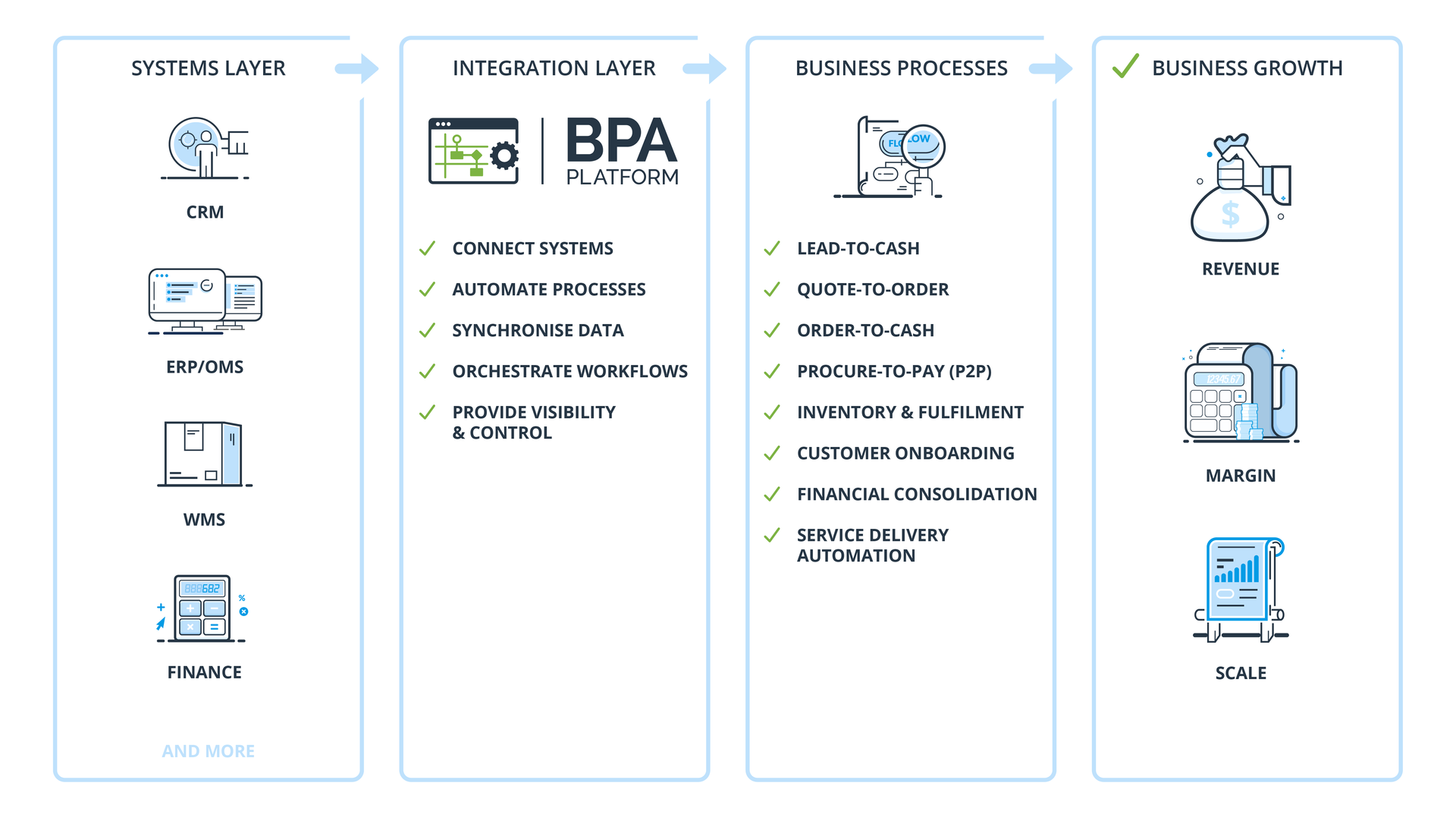
ERP integration is the process of connecting your ERP system to the other platforms your business relies on, so that data flows automatically between them without anyone manually entering it. When a customer places an order on your website, it shows up in your ERP. When a sales rep updates a customer record in your CRM, that information is reflected in your finance system. When an invoice goes out, the right people are notified without anyone having to chase it down.
The goal isn’t to replace your existing systems. It’s to make them work together. Most businesses already have the software they need. They just need it connected.
The Real Cost of Disconnected Systems
The cost of poorly connected systems rarely shows up as a single line item on a budget. It shows up as the hour your operations team spends every morning re-entering order data. It shows up as the sales rep who quoted a price based on inventory that had already shipped. It shows up as leadership making decisions from a report that was already out of date by the time it landed in their inbox.
Individually, each of these problems feels manageable. Collectively, they represent a significant drag on the business. And as you grow, the problem doesn’t get easier. It compounds.
What Good ERP Integration Looks Like in Practice
Let’s make this concrete. Here are four areas where ERP integration through BPA Platform makes a measurable difference:
Order processing from e-commerce
Orders placed through Shopify, Magento, BigCommerce, or WooCommerce are automatically imported into your ERP. Inventory updates in real time. Pick lists are generated. Shipping labels are created. No one needs to manually transfer that order data, and nothing falls through the cracks because somebody forgot to check a dashboard.
CRM and customer data
When a new customer is added in Salesforce, HubSpot, or Sage CRM, that record syncs to your ERP automatically. Account changes, pricing updates, payment history: your sales and finance teams are always working from the same information. The version problem goes away.
Finance and invoicing
Invoices are generated and distributed automatically. Approval workflows route purchase orders to the right people based on value thresholds. Credit control runs on a schedule rather than relying on someone remembering to follow up. Month-end becomes less of a scramble.
Reporting and visibility
When your systems share data, your reports reflect reality. Leadership can see how the business is actually performing today, not how it was performing when someone last exported a spreadsheet. That shift, from reactive reporting to real-time visibility, changes how decisions get made.
Why BPA Platform Works Well for This
BPA Platform is designed for businesses that need enterprise-grade integration without enterprise-grade complexity or cost. A few things that set it apart:
- It comes with native connectors for the most widely used ERP systems, including SAP Business One, Sage 100/300/500/X3, Sage Intacct, Microsoft Dynamics 365, and Acumatica. For systems not covered by a named connector, BPA Platform’s web service connector can be used to connect to most REST and SOAP APIs, giving businesses a practical path to integration regardless of the systems they’re running.
- It works across cloud, on-premise, and hybrid environments. You don’t have to rebuild your infrastructure to use it.
- It uses a drag-and-drop interface, so configuring integrations and automations doesn’t require a development team or a lengthy implementation project.
- It scales with your business. Whether you’re connecting two systems today or building a broader automation framework over time, the platform grows with your requirements.
What the Difference Looks Like
Consider a mid-sized distributor running SAP Business One alongside a Shopify store and a third-party warehouse management system. Before integration, every online order triggered a chain of manual steps: someone pulled the order from Shopify, re-entered it into SAP, then notified the warehouse separately. It worked, but it was slow, prone to errors, and entirely dependent on someone being at their desk to keep things moving.
After connecting those three systems through BPA Platform, orders flow from Shopify into SAP automatically, the warehouse receives pick instructions without any manual handoff, and inventory levels stay accurate across both platforms in real time. The team that used to spend the first two hours of every day processing overnight orders now has that time back. More importantly, the business can handle significantly higher order volumes without adding headcount to manage the administration.
That’s the real measure of good integration: not just that it saves time, but that it removes the ceiling on what your team can handle.
Where to Start
ERP integration doesn’t have to be a large, disruptive project. The most effective approach is usually to start with the connection that causes the most daily friction, whether that’s orders coming in from your e-commerce store, customer data living in two places at once, or reports that nobody quite trusts, and build from there.
The businesses that scale most effectively are the ones that build operational foundations capable of supporting growth before they need them. Integration is one of those foundations. A business with its systems working together can take on more customers, enter new markets, and move faster without the wheels coming off.
If your systems are creating more friction than they’re removing, it’s worth having a conversation about what a more connected business could look like. That’s exactly the kind of conversation we enjoy having at Fisher Technology.
_____________________________________________________________________________________________________________________________________________________________________________
Ready to Connect your Systems
Fisher Technology is the North American distributor for BPA Platform, helping businesses connect their ERP, CRM, e-commerce, and operational systems. Get in touch at www.fisher-technology.com/contact