
BPA Platform for SAP Business One Now Supports Release 10
Paul Cannon • March 3, 2020
Most businesses have already made the investment. There’s an ERP system handling finance, inventory, and operations. There’s a CRM managing customer relationships. There might be an e-commerce platform processing orders, a warehouse system tracking stock, and a courier integration handling shipping. Each one does its job. The problem is they don’t talk to each other.
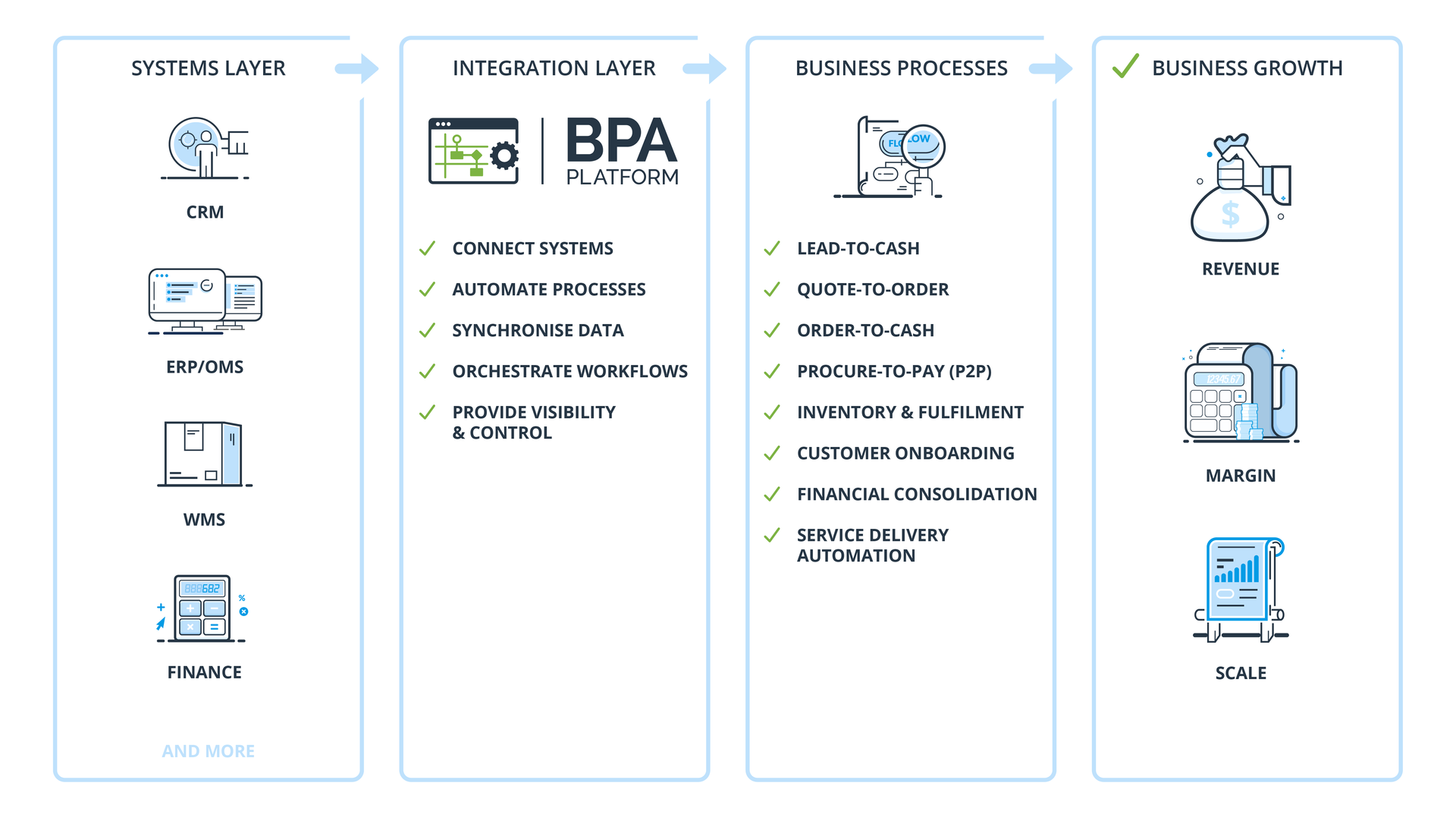
Growing a business is hard enough. The answer rarely means buying more software. It means making what you already have work together. Most businesses are running a mix of systems that each do their job reasonably well in isolation. Accounting in one platform, customer data in another, orders coming in through a separate channel entirely. The problem isn’t the individual tools. It’s the gaps between them. And those gaps, filled daily by manual workarounds, duplicated data entry, and out-of-date reports, are quietly costing more than most business owners realize. When those gaps close, something shifts. The business doesn’t just run more smoothly. It becomes capable of things it couldn’t do before. What disconnected systems actually cost you The cost of poorly connected systems rarely shows up as a single line item. It shows up as the hour your finance team spends every morning manually transferring data between platforms. It shows up as the sales rep who quoted a price based on inventory that had already sold. It shows up as the leadership team making decisions from a report that was already out of date by the time it landed in their inbox. Individually, each of these problems feels manageable. Collectively, they represent a significant drag on the business. Time that should be going into growth goes into workarounds. Decisions that should be made confidently get delayed because nobody quite trusts the data. And as the business grows, the problem compounds rather than resolves itself. Integration as a growth strategy, not an IT project There’s a tendency to think of system integration as something the IT department handles quietly in the background. That framing is part of the reason so many businesses stay stuck with systems that don’t work together. Integration is a business decision. When your systems share data seamlessly, your team spends less time moving information around and more time acting on it. When a new order placed online automatically updates your inventory, triggers a fulfillment workflow, and posts to your accounts without anyone touching it, that’s not just efficiency. That’s a business that can scale without adding headcount to manage the seams between systems. BPA Platform makes this kind of integration possible without requiring a team of developers or a lengthy implementation project. Using a simple drag-and-drop interface, it connects the systems your business already relies on and automates the workflows between them. The result is a business that runs more smoothly, responds more quickly, and is better positioned to grow. Connecting the systems you already have One of the most common concerns I hear from business owners is that integration sounds like it means replacing everything they’ve already invested in. It doesn’t. BPA Platform connects to the systems you already use, whether that’s Sage, SAP, Microsoft Dynamics, Salesforce, Shopify, or virtually any other platform your business runs on. That matters because most growing businesses have a mix of older, established systems and newer cloud-based applications. The platform that’s been running the business for a decade isn’t going anywhere, and it shouldn’t have to. BPA Platform works across cloud, on-premise, and hybrid environments, so you can build the connections your business needs without disrupting what’s already working. Security is built into the integration layer rather than bolted on afterward. Data moving between your systems is protected end to end, which matters particularly for businesses handling sensitive financial, customer, or operational information. What this looks like in practice Consider a business that sells through multiple channels. Orders come in online, through a sales team, and via wholesale partners. Each channel feeds into a different system. Without integration, someone is manually reconciling those orders, updating stock levels, and ensuring the accounts reflect what’s actually been sold. With BPA Platform in place, that entire process runs automatically. An order placed anywhere updates inventory everywhere, triggers the right fulfillment process, and posts to the accounts without a person in the middle. Or consider a leadership team that currently waits until month end to see how the business is performing. With automated reporting built on integrated data, that same team can have accurate, real-time visibility into the numbers that matter most, every day, without anyone spending time pulling the report together. These aren’t complex transformations. They’re the kind of straightforward improvements that free up your best people to focus on growth rather than administration. Growing without growing the complexity The businesses that scale most effectively are the ones that build operational foundations capable of supporting growth before they need them. Integration is one of those foundations. A business that has its systems working together is a business that can take on more customers, enter new markets, and move faster without the wheels coming off. BPA Platform is designed to scale with the business. Whether you’re connecting two systems today or building out a broader automation framework over time, the platform grows with your requirements rather than forcing you to start over when your needs change. If your systems are creating friction rather than enabling growth, it’s worth having an honest conversation about what that’s costing you and what a more connected business could look like. That’s exactly the kind of conversation we enjoy having at Fisher Technology. _________________________________________________________________________________________________________________________________________________________ Fisher Technology helps businesses across North America connect their systems and automate their workflows using BPA Platform. If you’d like to explore what better integration could mean for your business, we’d love to talk. Get in touch: www.fisher-technology.com/contact

Finance teams are often described as the engine room of a business. They keep the numbers accurate, the cash flowing, and the reporting on time. But in many organizations, a significant portion of that team’s energy goes into tasks that are repetitive, manual, and frankly not a great use of skilled people. That’s where business process automation comes in. And when it’s applied thoughtfully to finance, the results go well beyond efficiency gains. Done right, automation repositions a finance team from a cost center into something that actively contributes to business growth. The Problem With Manual Finance Processes Most finance teams are sitting on processes that haven’t changed much in years. Reports get generated by hand. Invoices are chased through spreadsheets and email threads. Credit control relies on someone remembering to follow up. Reconciliation happens in a mad scramble at month end. These tasks are necessary, but they don’t need to be manual. And when they are, the cost isn’t just time. Errors creep in. Deadlines get missed. Cash flow suffers. And the finance professionals who should be providing strategic insight spend their days on administration instead. “When skilled finance people spend their days on administration, the business loses the strategic thinking it’s paying for.” What Automation Actually Looks Like In Practice BPA Platform addresses this by automating the repetitive, rule-based work that clogs up finance workflows. That includes the automatic generation and distribution of invoices and statements, automated credit control procedures that send the right communication to the right customer at the right time, purchase order approval workflows that route requests based on value thresholds, and scheduled financial reporting that lands in the right inbox without anyone having to build it. The platform integrates with the accounting and ERP systems finance teams already use, including Sage, SAP, Microsoft Dynamics, and many others, so there’s no need to rip out existing infrastructure. Automation gets layered on top of what’s already working. A Real Example: What This Looks Like For A Finance Team One pattern that comes up consistently across BPA Platform customers is the reporting burden. Finance and operations teams often spend several hours every week manually building, formatting, and distributing reports that nobody has time to question or redesign because they’ve always been done that way. With BPA Platform’s reporting automation in place, those reports are generated and distributed automatically in real time. The staff time that was going into assembly gets freed up for analysis. Errors that crept in through manual data handling disappear. And the people responsible for financial reporting can focus on what the numbers mean rather than how to produce them. Codeless Platforms’ customers across industries have seen this play out in reporting, reconciliation, and financial administration. The time savings are consistent, and so is the observation that the real benefit isn’t just the hours recovered. It’s what the team does with them. Credit Control: Where Automation Directly Protects Cash Flow One of the highest-impact areas for finance automation is credit control. Late payments are one of the most common causes of cash flow pressure for businesses of all sizes, and most of the time, the problem isn’t that customers won’t pay. It’s that nobody followed up in a consistent, timely way. BPA Platform can monitor outstanding invoices daily, automatically generating and sending the right communication based on how overdue an account is. An approaching due date triggers a polite reminder. A missed payment triggers a follow-up. An aged debt triggers an alert to the collections team and the relevant account manager simultaneously. The whole process runs without anyone having to track it manually, and nothing falls through the cracks. For businesses that have implemented this kind of automated credit control, the results tend to show up quickly. Aged debtor times come down. Cash flow becomes more predictable. And the finance team spends less time chasing and more time managing. For businesses that have implemented this kind of automated credit control, the results tend to show up quickly. Aged debtor times come down. Cash flow becomes more predictable. And the finance team spends less time chasing and more time managing. The B roader Shift: From Reactive To Strategic The real value of finance automation isn’t just the hours saved, though those matter. It’s what becomes possible when the team has capacity to think rather than just process. Real-time visibility into cash flow. Faster month-end close. Earlier identification of risk. More informed conversations with leadership about where the business stands and where it’s heading. Finance teams that automate the routine work don’t just get more efficient. They get more valuable to the business. And that’s the transformation worth aiming for. “Finance teams that automate the routine work don’t just get more efficient. They get more valuable to the business.” --------------------------------------------------------------------------------------------------------------------------------------------------------------------------------------------------------------------------------------------- Fisher Technology helps organizations across North America implement BPA Platform to streamline finance operations and unlock the full potential of their teams. If you’d like to explore what automation could look like for your finance function, we’d love to talk. Get in touch: www.fisher-technology.com/contact