The New Normal: How We've Adapted

Kiara Walker • November 15, 2021

As we hit the half way point of the year, it’s more than safe to say that 2020 is truly one for the books. When you take a look back at all that’s transpired since March till now, we couldn’t have imagined that this year would’ve turned out this way. In the midst of a global pandemic, we’ve become accustomed to the “new normal” of social distancing and conducting business remotely. More importantly, we’ve learned the importance of maintaining relationships and effective communication during these trying times. 

As a family business, Fisher Technology has always prided ourselves on upholding the Fisher Difference. Even when transitioning to work from home, our team quickly adapted to the new realities of this pandemic to ensure that our customers and Partners receive the care and personal touch they expect and deserve.


Small Business Communication

It’s crucial to be proactive with your team to collaborate on projects and meet deadlines, especially with the implementation of work from home policies. Without question, safety is a top concern to many organizations, including our own. At Fisher, we’ve learned how to set daily agendas, maintain weekly strategy meetings, ask for guidance, and overall keep communication constant and flowing. Doing so limits errors that may arise from not being in-person together. Have a burning question or just want to share ideas? It gives you peace of mind to be able to know that you’re not alone while you work because your coworkers are only a Slack message or Zoom call away.


Support

#AloneTogether is a hashtag that’s become familiar in the last few months and serves as a reminder that even when separated physically, we can still be there for one another in other ways. Even since joining the Fisher Technology team last September, I’ve always felt supported and appreciated. But now, more than ever, and especially throughout this pandemic, I’ve gained a support system that I know I can count on. There’s a certain level of professionalism and personal touch that you just can’t get anywhere else but at Fisher. Our small team allows us to be nimble, detail-oriented, and driven toward positive results.


What's New?

So, what’s the Fisher team been up to during quarantine besides back-to-back Zoom calls and bottomless cups of coffee? In case you’ve missed it, in late April 2020, the latest version of BPA was launched, hosting a variety of new features:

  • New HTML Pro Tool
  • Retrieve text Message Tool
  • 200+ Feature Enhancements
  • New API


Our blog detailing everything new with BPA 2020 can be found here

Look out for our next blog update on ‘How Cooking is a Business Process Too!’

By Nicole Laurier April 2, 2026
Sit through enough software demos and a pattern starts to emerge. Somewhere between the slide on streamlined workflows and the one about real-time visibility, the presenter leans forward and drops the phrase: AI-powered. The room nods. Someone scribbles it down. And the question nobody says out loud is — what does that actually mean? To be fair, AI is genuinely changing enterprise software. Real progress is happening in how systems learn from data, flag problems early, and cut down on manual grunt work. This isn’t an argument that AI is all smoke and no fire. It’s an argument that not all AI is the same thing — and that mid-market buyers are getting a raw deal when it comes to telling the difference. The Pressure to Lead with AI Mid-market ERP and CRM vendors are caught in a tough spot. Enterprise players have poured billions into AI, and their customers are asking the same questions regardless of company size. So “AI-powered” has quietly shifted from being a technical description to a marketing checkbox — something that needs to show up on the website, in the pitch deck, and in the renewal conversation, whether the product genuinely justifies it or not. This isn’t a dig at any one vendor. It’s the water the whole industry is swimming in right now. When buyers expect AI and competitors are claiming it, stretching the definition becomes hard to resist. The result is a market where “AI-powered” can mean anything from a genuinely sophisticated machine learning model to a rebranded reporting dashboard. Both might be useful. But they’re not the same thing, and they shouldn’t carry the same price tag. What "AI-Powered" Often Looks Like in Practice at “AI-Powered” Often Looks Like in Practice A few patterns come up again and again: Predictions that are really just history repeating . If a system flags a customer as “at risk” because their order frequency dropped, that’s not a prediction — that’s a report. Useful, sure, but it’s been available for years. Platforms like BPA Platform have delivered exactly this kind of data-driven alerting and exception reporting through straightforward business rules and workflow logic — long before anyone was calling it AI. The capability was always real. The rebrand is what’s new. Automation dressed up as intelligence . Routing an invoice to the right approver based on a spend threshold. Triggering a follow-up when an order status changes. Escalating a support case that’s been sitting too long. These are rules-based processes — and BPA Platform handles them through its codeless automation engine without needing a machine learning model anywhere near them. They’re reliable, auditable, and they work. When vendors slap an AI label on this kind of automation, it doesn’t make the feature more powerful. It just makes the buying conversation murkier. Generative AI bolted on rather than built in . The scramble to add large language model features to existing products has produced some genuinely useful results — and some that are basically a chat window glued onto software that hasn’t fundamentally changed underneath. The question worth asking isn’t whether there’s a generative component. It’s whether it’s working from relevant data, wired into actual workflows, and backed by someone who’ll own the problem when it gets something wrong. A Simple Framework for Evaluating AI Claims A Simple Framework for Evaluating AI Claims You don’t need a data science background to push back on what vendors are telling you. A handful of direct questions will do most of the work: Whose data is it learning from — ours, or a generic model? A system trained on your business behaves very differently from one drawing on industry-wide averages. What happens when it gets it wrong? Every AI system makes mistakes. How a vendor answers this question says a lot about how seriously they’ve thought it through. Who owns it when something breaks or changes? Features tied to third-party models can shift behaviour when those models are updated. That’s a support question, not a technical footnote. Can we see it running in a live environment? Demo environments are controlled by design. Asking to speak with a reference customer who uses the feature in production is a completely fair request — and the answer tells you a lot. So, What Should You Actually Do? What Should You Actually Do? None of this is a case for tuning out AI conversations entirely. Informed skepticism is different from blanket cynicism. AI is developing fast, and what isn’t quite there yet could look very different in two or three years. The vendors worth watching are the ones building seriously on solid data foundations — and being straight with customers about what’s ready and what isn’t. The ones worth being cautious about are using AI language mainly to justify price rises, paper over product gaps, or match a competitor’s latest press release.  Your business deserves sharper questions than that. Ask them. The vendors with real answers won’t mind. ------------------------------------------------------------------------------------------------------------------------------------------------------------------------------------ Full disclosure: this blog was written with the help of Claude, Anthropic’s AI assistant. Yes, we’re aware of the irony — a post about not blindly trusting AI was drafted with the help of AI. But that’s rather the point. Used thoughtfully, with a human steering the ideas, challenging the output, and rewriting the bits that sounded like a robot trying to sound like a person, AI can be a genuinely useful tool. It didn’t write this. It helped write this. There’s a difference — and that difference is exactly what this blog is about.
By Nicole Laurier September 8, 2025
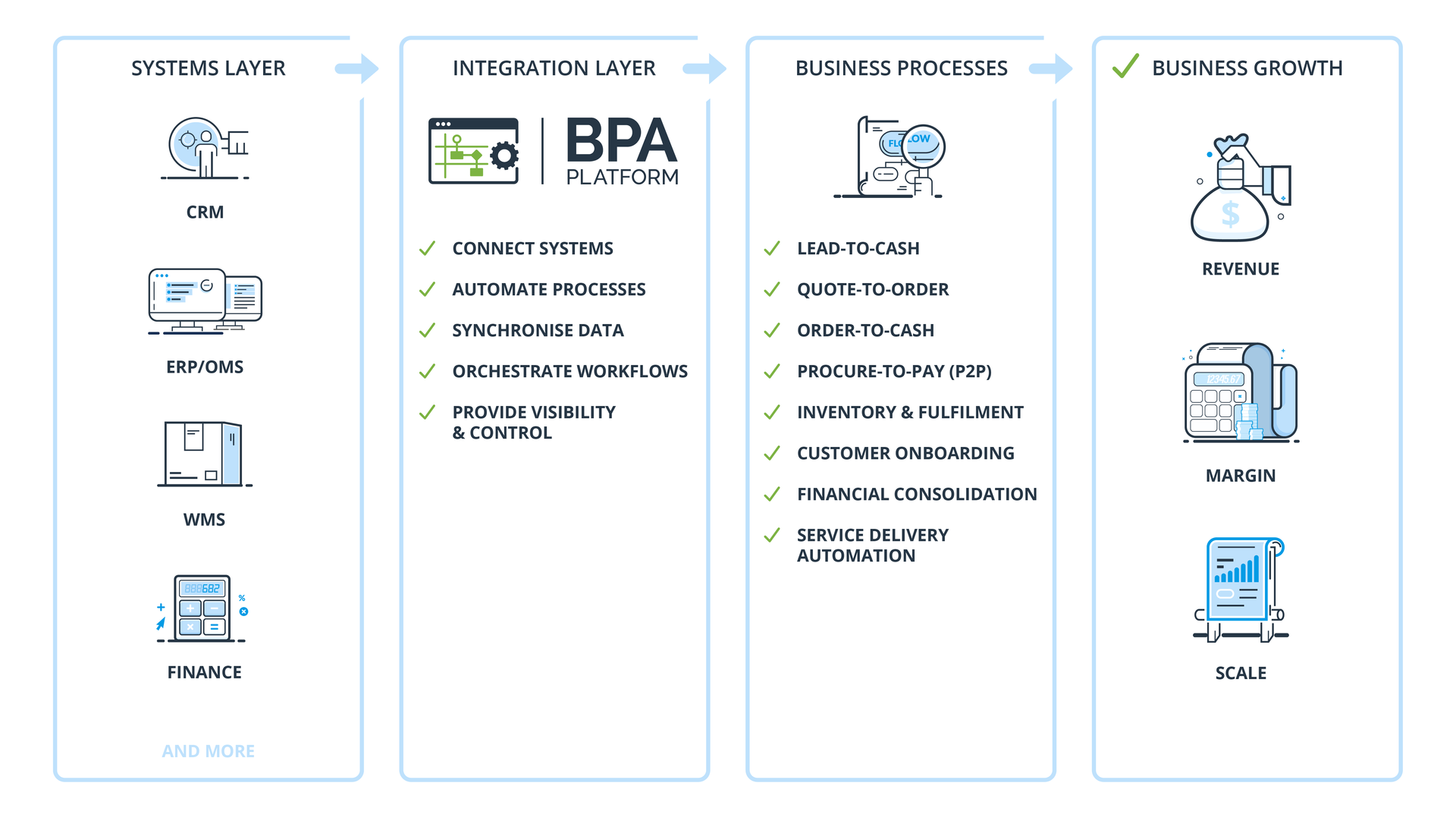
Automation in finance plays an important role for an organization and is a key driver for moving the company forward. With the right automation tools, finance teams can directly impact the bottom line, accelerate cash flow, and unlock new growth opportunities. BPA Platform empowers finance professionals to transform from cost centers into profit generators, delivering measurable revenue impact across every financial process. From Cost Center to Revenue Engine: The Finance Transformation Traditional finance departments focus on expense management and compliance. But forward-thinking organizations are leveraging finance automation to drive revenue growth. BPA Platform enables this transformation by connecting financial processes directly to revenue outcomes, turning every automated workflow into a growth opportunity. When finance teams eliminate manual bottlenecks, they don't just save time—they accelerate revenue recognition, improve cash conversion cycles, and enable faster business decisions that capture market opportunities. This strategic shift positions finance as a competitive advantage and primary driver of company growth. Finance Automation with BPA Platform Cash flow is the lifeblood of revenue growth. BPA Platform's finance automation directly impacts your company's ability to generate and collect revenue by streamlining critical cash flow processes: Automated invoice generation reduces billing cycles from days to hours Intelligent payment routing accelerates customer payment processing Real-time payment tracking eliminates revenue recognition delays Automated dunning processes recover revenue faster from slow-paying customers Poor credit management doesn't just create bad debt—it destroys future revenue opportunities. BPA Platform's credit control automation protects revenue while enabling growth: Real-time monitoring identifies customers before they become collection problems Automated workflows prevent revenue leakage from account management gaps Integrated communication tools maintain sales relationships during collections BPA Platform transforms financial reporting from a backward-looking compliance exercise into a forward-looking revenue optimization tool: Real-Time Revenue Analytics Automated data consolidation provides instant revenue visibility Dynamic dashboards identify revenue trends as they happen Predictive analytics forecast revenue opportunities and risks Automated variance analysis highlights revenue optimization opportunities Strategic Decision Acceleration Automated reporting eliminates month-end delays that slow business decisions Real-time profitability analysis guides revenue-focused resource allocation Instant scenario modeling evaluates revenue impact of strategic options Core BPA Platform Solutions That Drive Revenue Journal Entry Automation: Revenue Recognition Acceleration Manual journal entries create dangerous delays in revenue recognition. BPA Platform's automated journal processing ensures revenue hits the books immediately when earned; eliminating month-end revenue recognition bottlenecks, enabling faster financial closes and more timely business decisions. Expense Management: Maximizing Profit Margins Every dollar saved in expense processing flows directly to profit margins. BPA Platform's expense automation doesn't just cut costs—it amplifies revenue impact. Expense savings from automation can be reinvested into revenue-generating activities, creating compound growth impact. Intercompany Management: Scaling Revenue Across Business Units Growing companies often struggle with intercompany transactions that slow revenue recognition and create compliance risks. BPA Platform enables seamless revenue flow across business entities eliminating intercompany transaction delays that prevent timely revenue recognition and business unit optimization. BPA Platform for Revenue-Driven Finance Transformation  The most successful companies don't just manage finances—they leverage finance automation to drive revenue growth. BPA Platform provides the tools, integrations, and insights needed to transform your finance team from a cost center into your company's most powerful revenue driver. Your digital transformation starts with one conversation—and the sooner it begins, the sooner you gain the competitive edge. Contact Fisher Technology to discover why organizations across North America trust us to deliver automation solutions that drive efficiency, agility, and growth.
By Nicole Laurier August 5, 2025
Organizations struggle with a fundamental challenge: their critical business data lives in two worlds. Essential systems remain on-premise for security and compliance reasons, while new cloud applications promise enhanced functionality and scalability. The result is often data silos, manual processes, and frustrated users who can't access the information they need when they need it. BPA Platform recognizes this reality and delivers what organizations actually need: a single integration and automation platform that works seamlessly across Cloud, On-Premises, or Hybrid environments without forcing businesses to choose just one deployment model. How BPA Platform Addresses Hybrid Integration Challenges Modern enterprises operate in a complex ecosystem where legacy on-premise systems must work harmoniously with cloud-based applications. This hybrid environment presents unique challenges including data synchronization, security concerns, varying communication protocols, and the need for real-time connectivity. Organizations require solutions that can maintain data integrity while enabling seamless workflows across both environments. BPA Platform addresses these challenges through: Tasks & Steps Framework - BPA platform provides the ability to build flexible automation processes with logical building blocks using an intuitive drag-and-drop interface. Comprehensive Tool Library - BPA platform includes tools used to create steps within a task, providing functional building blocks that interface with common technologies, systems, and applications across cloud and on-premise environments. Secure Integration - BPA Platform integrates cloud-based, on-premises, or hybrid hosted business systems using end-to-end AES 256 security with double encryption to protect business data and transactions. This security-first approach ensures that sensitive data remains protected regardless of where it travels. Flexible System Architecture - BPA platform can be deployed on-premises or as an iPaaS (Integration Platform as a Service). It uses client software to design tasks, a server for connectivity and processing, and a data store for data and tasks. Multi-Protocol and Format Support - BPA Platform empowers you to bring all your data workflows together, supporting a wide variety of file formats and protocols including XML, CSV, JSON, HTTP, SMTP, OAuth, and more to drive your business forward seamlessly across different systems and applications. This comprehensive protocol support ensures that virtually any system can be integrated without requiring costly custom development. For organizations looking to optimize their hybrid IT architecture, BPA Platform's cloud integration solutions offer a proven path to success, combining the reliability of on-premise systems with the scalability and innovation of cloud platforms. Benefits of BPA Platform BPA Platform delivers comprehensive integration value through key capabilities that address critical enterprise needs: Reduced Development Time and Costs - BPA Platform significantly reduces system integration development times and costs while supporting integration with any data source. The platform provides flexibility to maintain, configure, and adapt data synchronization as business requirements change. Universal Connectivity - Connect to any SaaS or on-premises application or system through an extensive library of pre-built connectors and business process automation tools. This eliminates integration limitations and reduces implementation time. Scalable Architecture - Multi-instance architecture ensures reliable performance with multiple integration processes running simultaneously. Enhanced fault tolerance maintains system stability and business continuity. Flexible Processing - Support for both real-time processing and batch data integration handles different business requirements within a single platform, from immediate data synchronization to large-volume reporting tasks. Enterprise Security - Powerful authentication, access control, and data encryption protect sensitive information throughout the integration process, ensuring compliance with regulatory and corporate security requirements. These benefits deliver immediate ROI through faster integration development, improved operational efficiency, and reduced maintenance overhead while positioning organizations for long-term integration success. Hybrid Integration Excellence with BPA Platform As organizations advance, the need for flexible, secure, and scalable integration solutions becomes increasingly critical. BPA Platform empowers businesses to achieve true hybrid integration, seamlessly connecting systems and applications across both cloud and on-premises environments. Designed to support a multilayered, enterprise-wide technology architecture, BPA Platform enables complete interoperability between your existing tools and future innovations. This not only solves today’s integration challenges but also provides a resilient foundation for growth, adaptability, and the adoption of emerging technologies. By choosing BPA Platform, organizations position themselves for long-term success — with the agility to support evolving business models and ever-changing market conditions. Ready to Transform Your Integration Strategy? For organizations looking to optimize their hybrid IT architecture, BPA Platform's comprehensive integration solutions offer a proven path to success, combining the reliability and control of on-premise systems with the scalability and innovation of cloud platforms. Whether you're supporting multiple applications across multi-cloud environments, enabling digital transformation initiatives, or ensuring compliance with industry regulations, BPA Platform delivers the secure, flexible connectivity your business needs to thrive.  Ready to discover how BPA Platform can transform your organization's integration capabilities? Contact Fisher Technology today; we can assess your current environment, understand your business objectives, and provide you with a clear roadmap to integration success!